


Smartphone Gaming in 2026: The Era of Platform Collision
The boundaries that once separated "mobile gamers" from "console gamers" are rapidly dissolving.
According to the Video Gaming Report 2026 by the Boston Consulting Group (BCG), the industry is entering a phase defined by "Platform Collision." Their research highlights a shift toward a "hardware-agnostic" future, where the boundaries between console, mobile, and PC are breaking down.
Simultaneously, data from Udonis indicates that while download growth has stabilized, the market revenue is increasingly driven by high-fidelity "core" genres like Strategy and RPGs, which now command significant market share.
For serious gamers, this data signals a widening gap between software ambition and standard hardware capabilities. Below is our analysis of four critical shifts defining the 2026 landscape, supported by the latest industry reporting.
Trend 1: "Platform Collision" and The Expectation of Parity
Source Material: BCG Video Gaming Report 2026

The central thesis of BCG's 2026 report is that platforms are colliding, driven by the rise of cloud gaming and cross-platform ecosystems. The report notes that cloud gaming revenue alone is projected to grow significantly by 2030, pushing the industry toward a future where the device is secondary to the ecosystem.
The Industry Context:
-
Platform Convergence: Players increasingly expect to transition sessions between devices without losing fidelity or progress.
-
The Gen Z Factor: BCG notes that 55% of gamers report playing more in the last six months than they did previously, indicating a deepening engagement across platforms.
The Hardware Reality: As platforms collide, the expectation for "feature parity" on mobile increases. Running cross-platform engines (often ported from PC/Console) places a sustained load on mobile SoCs. For many standard devices, maintaining this parity over long sessions becomes a thermal challenge, potentially necessitating active cooling solutions to prevent frame-rate variance during cross-play scenarios.
Trend 2: The Revenue Shift to "Core" Genres
Source Material: Udonis Mobile Gaming Statistics 2026
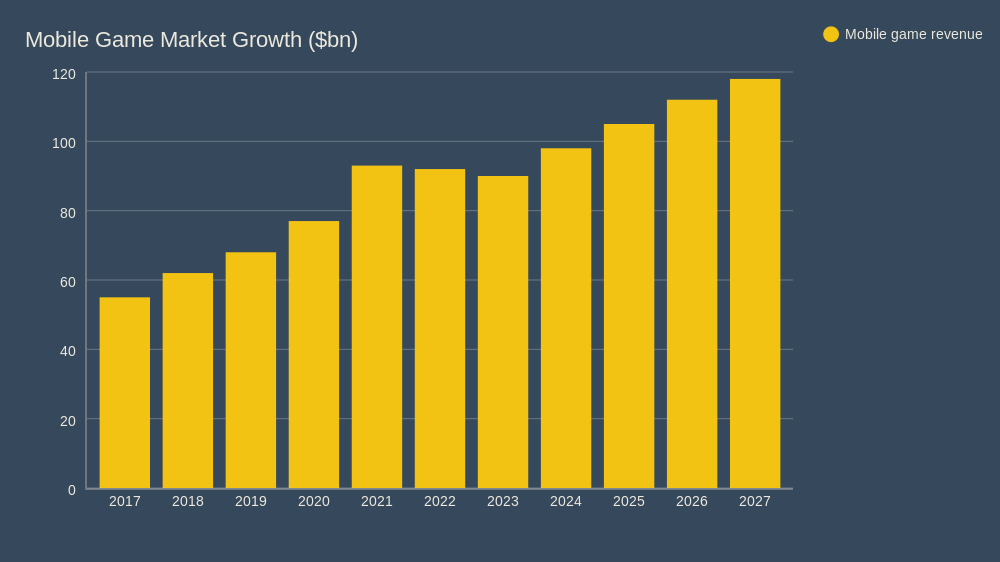
While hyper-casual games remain popular for downloads, the revenue landscape has shifted toward complex, resource-intensive genres.
Key Data Points:
-
Strategy & RPG Dominance: Udonis reports that Strategy games generated approximately 21.4% of total revenue despite making up only 4% of downloads, while RPGs generated nearly $16.8 billion.
-
Shooter Stability: The Shooter genre continues to generate over $4.3 billion, maintaining its position as a key revenue driver.
The Hardware Reality: These are not passive experiences.
-
Input Precision: Competitive Shooters and MOBA titles require precise inputs that can be difficult to achieve on touchscreens alone, validating the utility of hardware-based shoulder triggers for competitive play.
-
Computational Load: Strategy titles often involve complex AI calculations and high unit counts, which can sustain high CPU usage distinct from pure GPU graphical rendering.
Trend 3: The "15-Minute" Thermal Threshold
With the shift toward "Core" genres comes a shift in session length. As game loops are designed for retention, players are engaging in longer continuous sessions.
The Technical Constraint: Independent studies on smartphone thermal behavior have observed that standard flagship devices can reach thermal throttling thresholds relatively quickly under heavy loads.
-
Throttling Windows: Research has shown that surface temperatures can rise significantly within 10 to 20 minutes of intensive 3D gaming or high-throughput tasks.
-
The Impact: To protect internal components, standard devices typically reduce CPU/GPU frequencies once skin temperatures approach 45°C.
The Hardware Reality: For gamers playing 30-minute ranked matches or hour-long RPG raids, this "15-minute wall" presents a tangible obstacle. Devices utilizing Active Liquid Cooling (internal fans) are designed specifically to extend this peak performance window, bypassing the passive saturation point that affects standard vapor chambers.
Trend 4: The AI-Driven Development Shift
Source Material: BCG Video Gaming Report 2026
Perhaps the most significant long-term trend is the integration of AI into game development.
Key Data Points:
-
Widespread Adoption: BCG estimates that approximately 50% of game studios are now using AI in their workflows.
-
Immersive Innovation: This technology is being used to create smarter NPCs, dynamic environments, and more complex code structures.
The Hardware Reality: As developers utilize AI to increase asset density and logic complexity, the baseline requirement for mobile hardware rises. Games are becoming "smarter" and heavier. For the end-user, running these AI-enhanced environments likely means higher power consumption and heat generation, further emphasizing the need for robust thermal management systems in gaming-focused devices.
Conclusion: Bridging the Gap
The data from 2026 paints a clear picture of an industry in transition.
-
BCG confirms the collision of platforms and the rise of AI.
-
Udonis confirms the dominance of complex, high-revenue genres.
-
Technical studies confirm the physical thermal limits of passive cooling during these longer, heavier sessions.
The software has evolved to offer console-like depth, but this evolution demands hardware that can sustain it. For the dedicated gamer, the choice of device is no longer just about screen size—it is about thermal endurance.